Transforming Problem Behaviors with the Power of Enrichment
The Missing Piece to Your Training Plan: Why Enrichment Matters
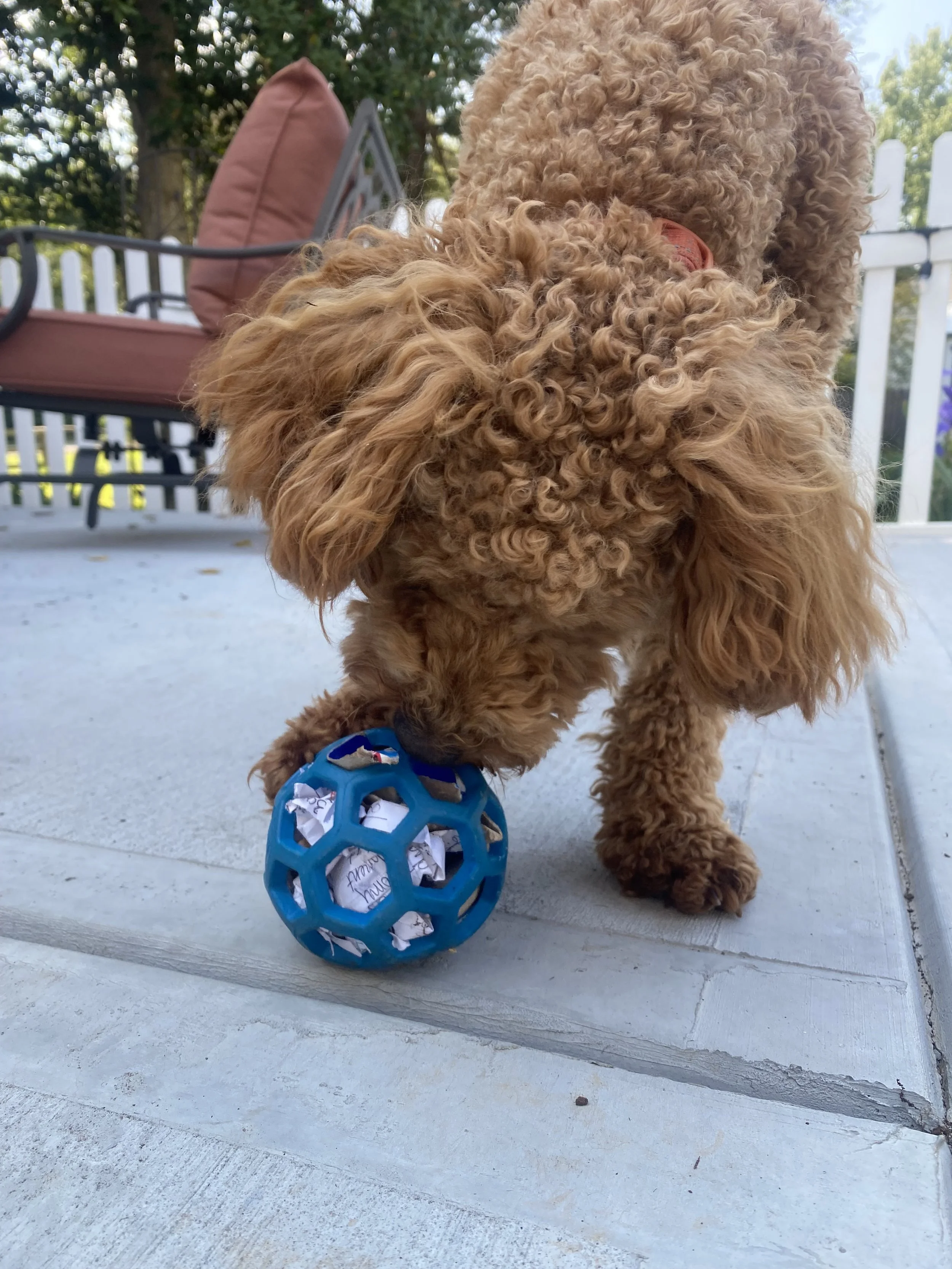
Teddy tries to figure out how to get the crumpled paper out of the Hol-ee Roller to get to the treats inside.
Enrichment has become a buzzword in the pet world in recent years. All over stores and the internet, you see fancy food puzzles, snuffle mats, and lick mats. You might have even spent a lot of money on these things, only to find out your dog thinks they’re too easy, too hard, or you forget to use them…so they’re collecting dust.
Truth is, store-bought items are just one small piece of the puzzle. Good enrichment strategies (combined with management and training) can actually help solve behavioral issues?
My most recent “enrichment helps the problem situation” adventure was with Teddy the master gardner. Unfortunately his humans do not agree, and really don’t like it when Teddy tries to move potted flowers from one pot to the middle of the yard.
Why does Teddy do it?
He enjoys tugging and shredding, so pulling a plant out of the pot gives him that satisfying resistance.
He LOVES attention, so grabbing flowers and running off turns into a fun game of chase.
By giving Teddy appropriate shredding options outside and rewarding him for using those instead, I found he was much less interested in destroying the garden.
What Is Enrichment (Really)?
Enrichment for animals has been studied for decades. Dr. Hal Markowitz was leading the research in zoological settings and found that enrichment is the process of setting up an individual’s environment to allow for choice and control in demonstrating species-typical behaviors. This, in turn, enhances their well-being.
Basically, it means we are fulfilling all of an individual’s biological, emotional, social, and cognitive needs.
Think about your own dog—what “problem behaviors” do they have that might really just be an unmet need for enrichment?
Natural Dog Behaviors: The Good, the Bad, and the Messy
Species-typical behaviors of dogs can look like sniffing, stealing items, digging, chewing, barking, jumping, and shredding. These are all things dogs do naturally, even if we as humans don’t always appreciate them.
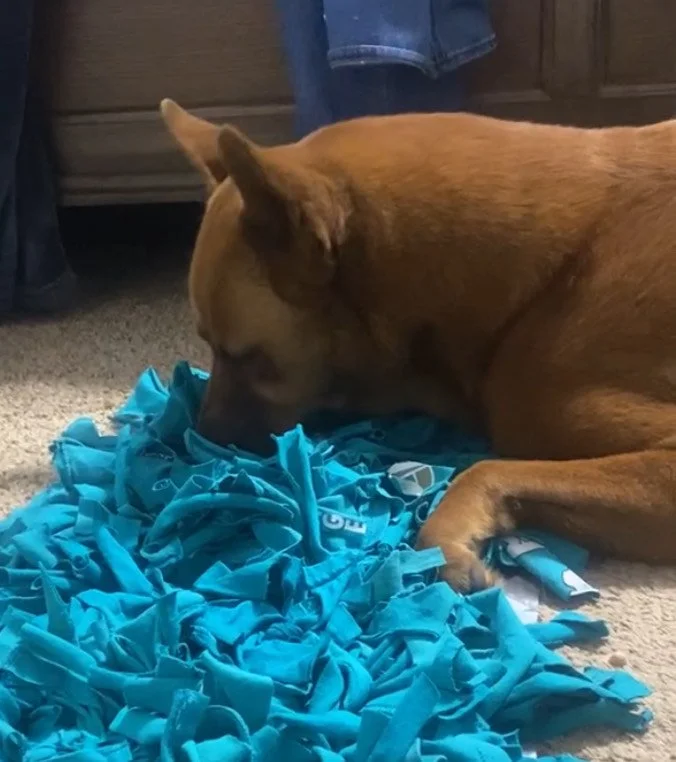
Sully snuffles through a homemade snuffle mat to find any crumbs left behind.
For example, if you have a dog that likes to jump on counters or dig through the trash, giving them foraging opportunities on the floor away from the kitchen can fulfill that need without the hassle.
Here are 3 easy ways to meet your dog’s foraging needs without buying anything new:
Scatter their kibble in the grass, snuffle mat, or around the house (safe areas only).
Hide treats in empty toilet paper rolls for a shreddable activity.
Toss a handful of food into a box filled with crumpled paper for them to dig through.
How Enrichment Solves Problem Behaviors
When we think about one of our dog’s problem behaviors we have to do some investigating before we can just give them enrichment. The right activity is only given if it meets our goals, and our dog’s needs. For example, pulling on walks is one of the most common complaints I hear about dogs. To choose the enrichment strategy that can help with the problem (along with management and training), we need to dig a little deeper and figure out why they are pulling.
Are they trying to say hi to everyone?
Do they want to sniff every bush?
Do they simply have too much energy to contain themselves?
Once you know the answer, you can make an enrichment plan that helps you begin to solve the pulling problem. This could include:
A training session to build up focus on you
More sniffy walks on a long line
A game of fetch or flirt pole before the walk
Think back to the “problem behaviors” you thought about before. Can you come up with 2-3 possible explanations for why they do that behavior?
Building an Enrichment Plan That Grows With Your Dog
Enrichment isn’t a one-time thing, nor is it one-size-fits-all. Your dog is an individual, and their needs are going to change over their lifespan. By giving them the chance to be a dog as much as they can, in safe and appropriate ways, you’ll enhance their overall well-being.
You can also check out this Enrichment Activities playlist for more ideas!
Need Help Getting Started?
If you’re not sure where to start, or if your dog’s behavior is still a challenge, I’m here to help! Let’s work together to create an enrichment and training plan that meets both your and your dog’s unique needs. Reach out for a 1-1 session today!
Hi! I’m Beccy and I’m a professional dog trainer with almost 15 years of animal training experience. I use positive reinforcement and fear-free methods to help dogs and their humans build skills, confidence, and lasting behavior change. My goal is to create a stress free life for you and your dog. I offer in-home training in Maryville, TN and surrounding cities throughout Blount, Sevier, Knox, and Loudon Counties. Online training is available for clients outside of East TN.
