
Can I Train My Reactive Dog Myself?
If you've found yourself on the other end of a leash while your dog barks, lunges, and loses their mind at a passing stranger, a bicycle, or another dog welcome, you’re not alone.
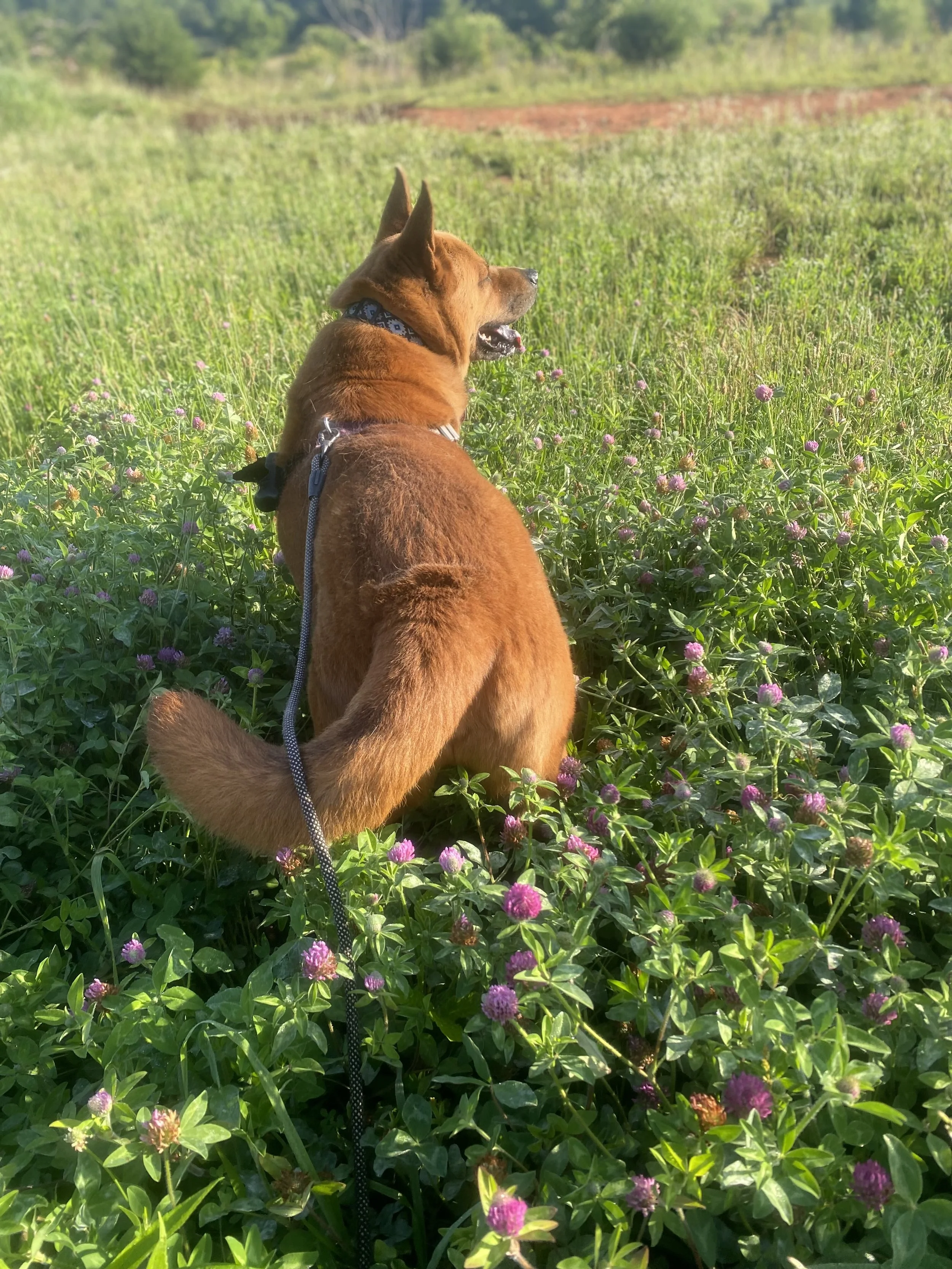
Sully stands in a field looking off to the distance taking in the environment. As long as there are no people or garbage trucks on the street he has a relaxing time.
The first thing I want you to hear is you're not a bad dog owner, and your dog is not a bad dog. Society has a way of making us feel like we are. When a dog pulls and barks in public, the judgment is immediate. From strangers on the street, neighbors watching from their front porches, sometimes even from well-meaning friends and family. The message we hear is that a reactive dog is a reflection of our failure. But I’m here to tell you: it isn't.
Your dog is reacting to the world around them in the way they believe they need to. That's not wrong of them. That's a dog trying to cope with their fears and anxieties. That’s something we can work with.
So, What Even Is Reactivity?
Reactivity is the dog's reaction to the environment around them. We see it as an over reaction. Those things our dogs are overreacting to are called triggers.
Reactivity can be hard and confusing because the triggers aren't always obvious or consistent. Some dogs react to strangers in public but greet guests at home like long-lost friends. Some are fine with people but cannot handle when those people are moving like with bikes, cars, or skateboards. Some love certain dogs but not others or seemed totally fine as puppies and then, somewhere around age 1 or 2, everything changed.
That inconsistency is part of why reactivity is hard to understand from the outside. There isn't always a clear common denominator, which makes it hard to explain, predict, or prepare for.
What's almost always true, though, is that the behavior looks scary, and can be dangerous if not handled well. And the shame that comes with it is real.
Can You Train Your Reactive Dog Yourself?
I’m going to give you the tried and true answer…it depends.
If you start early enough, like when the first signs appear, not years into an escalating pattern, you might be successful doing it on your own. The longer reactive behavior goes unaddressed, the more practiced and ingrained it becomes. If your dog has been lunging and barking for three years, you have more to untangle than if you'd caught it at six months.
Here's what I've learned from working with clients: by the time most people reach out for help, they've already tried the DIY approach. They've Googled. They've watched YouTube. They've read the books. And they're still stuck. Not because they're doing it wrong exactly, but because the information they found didn't break things down small enough, didn't account for their specific dog, and didn't tell them what to do with their dog in their environment.
One of the first questions I ask clients is: "What have you already tried and what worked, even a little?"
That line of questioning tells me a lot. Because the truth is, training protocols aren't one-size-fits-all. What worked for someone's anxious dog in the suburbs may do nothing for a nervous dog in an apartment building. The variables that do matter: your dog's physical, mental, and emotional well-being, and your own schedule and bandwidth, and capabilities. All of it shapes what approach will actually work.
There's also such a thing as too many tools. Decision fatigue is real. When someone has read ten different methods and tries each one twice before moving on, nothing gets a chance to work. Part of what I do is help people figure out what to focus on, and in what order.
I Know Reactivity All Too Well
Tigerlily, is my 7 year old corgi who has been one of my greatest teachers on this topic.
Looking back, her reactivity was probably there from the beginning. As a puppy, she would bark and lunge at people (especially women) and at moving objects like cars and bikes. We were also walking her alongside our two other dogs at the time, who had their own reactivity, which wasn't helping anything.
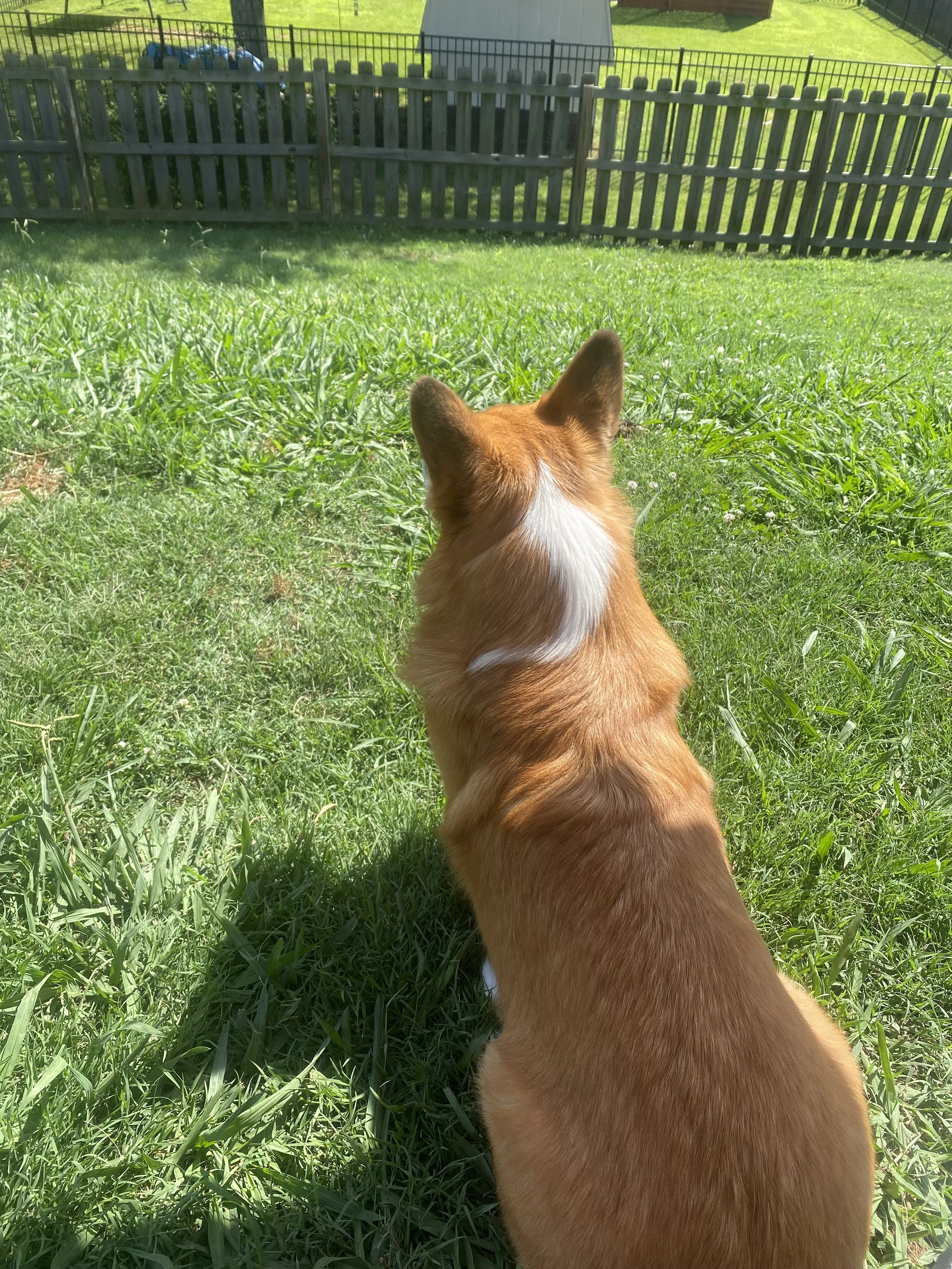
Tigerlily used to always bark and run the fence line when she would see the neighbor dogs out. Now she has more days of hanging out and just observing than barking.
Around age 2, things escalated significantly. She was reacting to nearly everything on walks: people, dogs, bikes, you name it. We also started seeing aggression toward one of our other dogs inside the house, and she'd fence-fight with the neighbor's dog whenever they were both outside.
We sought help from a veterinary behaviorist and her trainer. The focus was on management and medication. And at the time that was all my partner and I could do. Our lives were too busy and also the ailing health of one dog was taking up time, so training got put on the backburner.
Over time, some things shifted on their own. When the dog she'd been fighting with passed away, the in-home aggression resolved. But the reactivity on walks remained. My approach was a combination of not walking her in busy areas, using "look at me" techniques to redirect her attention long enough to create distance, and moving well off the path whenever I spotted a potential trigger ahead.
Then I went through my dog training certification, and everything started to fall into place. I began to learn the subtle body language signals that most people (myself included) miss entirely. I learned to read what body language signals happened before she tipped into explosive behaviors. I could support her in disengaging from a trigger and going to self-regulate, rather than waiting until she was already too far gone.
Today, Tigerlily is still reactive but living her best life. We're not walking in busy areas. I don’t take her out to public places. I know what it looks like to set her up to fail, so I avoid those situations. We do mental and physical activities at home, so she gets all her needs met.
Has she been "cured"? No. Is she thriving? Absolutely.
That's my goal.
The Thing Most People Skip: Body Language
If I had to name the single most important foundation for working with a reactive dog, it would be this: learn to read your dog’s body language.
Most of us aren't taught to read dog body language in any depth. We can spot the obvious stuff, like the full-on lunge, the hackles up, the growling and barking. But by the time those signals appear, your dog isn’t able to use any skills and you just have to get out of dodge.
The slight stiffening of the body. The shift in ear position. The subtle freeze before the tension builds. Learning to recognize those early signals and responding to them before your dog escalates is what changes the trajectory of a walk from a disaster to a success.
This is also why so much DIY training stalls: the advice online focuses on what to do when the dog is reacting. But the more useful question is what to do in all that time before they react.
When Do You Need Professional Help?
Once again…it depends.
It depends on your goals, your skills, and how much energy you want to put in looking up and applying information, rather than someone teaching you. It depends on how much your dog's reactivity is affecting their quality of life and yours. And it depends on the safety of everyone.
Go back to my example of Tigerlily. She still has reactive tendencies. But I know how to manage it, and I don’t put her into situations where we both have to work harder to be successful. But if my goal was to be able to take her to the farmers market with me on Saturday, I would have to do A LOT more training.
If there's any risk of a bite to a person, to another animal please don't go this alone. That's not a reflection of failure; it's a recognition that the stakes are high enough to need a professional.
For most reactive dogs, though, the answer isn't "DIY" or "hand this over to a professional." It's usually: get the right information, in the right order, with enough support to make it stick. A qualified professional trainer can help you do it well.
The Part Nobody Talks About: The Emotional Weight of This
I want to be honest about something that rarely gets talked about.
Living with a reactive dog can be emotionally hard.
There's grief. Grief for the dog walks you imagined, for the dog park visits that aren't possible, for the version of having a companion dog that seems so easy for everyone else. There's embarrassment when your dog erupts in public and strangers stare. There's guilt every time you leave your dog home because taking them would be too much.
That's all real. And it deserves to be acknowledged, not glossed over.
What I have seen though, is that when people start to make progress. Like when they have a walk where their dog notices a trigger and looks at them instead of lunging, the feeling is so cup-filling. Not just for the dog, but for the humans too.
Reactivity work is slow. It requires consistency, patience, and the willingness to manage your dog's environment rather than just trying to push through every difficult situation. But the changes that come from doing it right are lasting ones.
Where to Start
If you're just beginning this journey, here's what I'd suggest:
Manage before you train. Creating distance from triggers, choosing low traffic environments, and adjusting your walking routes. This will reduce your dog's stress load so their nervous system has room to learn.
Start to observe. Before you try any training technique, spend a week just noticing your dog. What's their body language look like? Both when they are relaxed and when they start to escalate. This is the foundation everything else is built on.
*Note: Please don’t put your dog in unsafe situations or try to get reactivity to happen. That’s the opposite of what we want.
Look for positive reinforcement and fear-free methods. Punishing a reactive dog typically makes things worse, not better. It adds stress to an already stressed animal and can increase the unpredictability of behavior. Fear-free and positive reinforcement approaches work with your dog's emotional state rather than against it.
Get support sooner rather than later. You don't have to wait until things are at a crisis point. A qualified trainer can help you build a plan that's specific to your dog.
Your reactive dog isn't broken. They're not bad. They are a dog who needs your help understanding that the world isn't as threatening as it feels to them right now.
And you showing up, learning, asking questions are already doing something right.
Looking for a qualified trainer that will work with your reactive dog and tailor the training plan to your needs? Search no longer. I will be hosting a free webinar on reactivity. You can sign up for “Barking, Lunging, Pulling: Turning Stressful Walks Into Successful Ones by clicking here.
Hi! I’m Beccy and I’m a professional dog trainer with almost 15 years of animal training experience. I use positive reinforcement and fear-free methods to help dogs and their humans build skills, confidence, and lasting behavior change. My goal is to create a less stressful life for you and your dog. I offer in-home training in Maryville, TN and surrounding cities throughout Blount, Sevier, Knox, and Loudon Counties. Online training is available for clients outside of East TN.
