How to Get Your Dog to Actually Go to Their Safe Space When It Matters
Welcome back to part 3 of teaching your dog how to use and love their safe space.
What you should have accomplished by now:
Observed your dog’s preferences to create them the ideal space to relax
Taught your dog to go to that place on a verbal cue
Helped your dog to relax and get cozy in the space
Go back and read Part 1 and Part 2 if you haven’t started any of these. If you’ve already done the work then now we’re going to teach them how to utilize this space when they are having a hard time (whatever that looks like for your dog).
Body language is the key to success
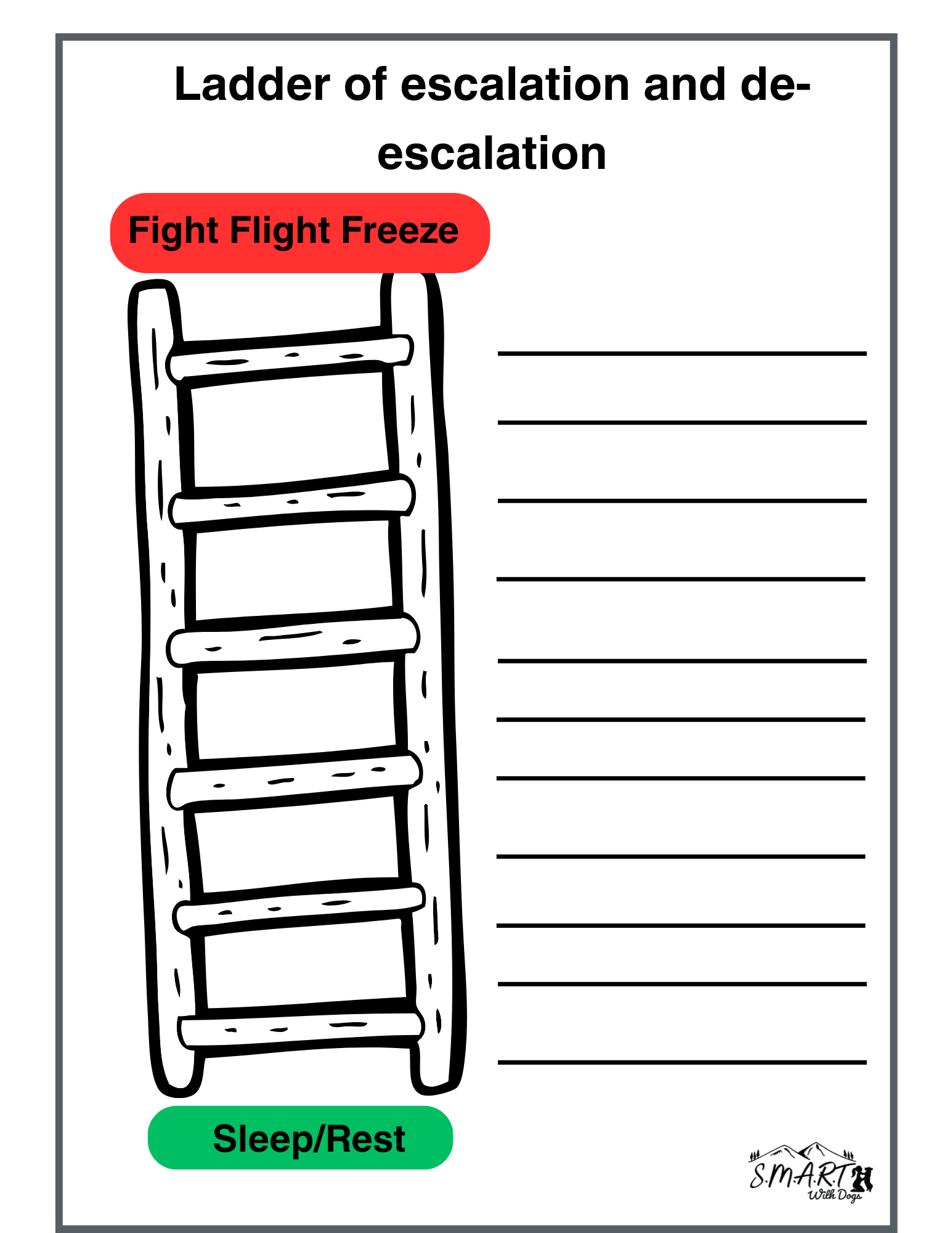
Image of a ladder of escalation and de-escalation. The blank spaces represent the different body language signals your dog would display as they move up and down their own ladder.
By now you should know that learning your dog’s body language is one of the most important parts of the process. Knowing what it looks like early on when your dog starts to have those big negative feelings can be the difference between avoiding an explosion and having to recover after you both have had a meltdown.
Think of each of the body language signals as a rung on a ladder. At the top of the ladder is the fight/flight zone and the bottom is rest/sleeping. We call these the ladder of escalation and ladder of de-escalation. As your dog starts to move up their ladder towards fight or flight, their body language escalates, and as they start to self regulate and de-escalate they move down towards sleep and rest.
Take a few moments and write down each of the body language signals you notice as your dog moves up and down their ladder.
Now that you have a list written down, we’re going to use that to teach your dog when to head to their safe space.
Get to movin’
You want to start this part of the practice BEFORE your dog feels stressed. None of us learns and retains new information under pressure. Which means you need to do this when your dog is having a good day-whatever that looks like to them.
When you’re ready you’re going to get your dog’s attention, excitedly encourage them to follow you, go grab a calming project, then run them quickly to their safe space. Drop the calming project on their spot and let them relax.
*Tip: Don’t do this if they are already resting. Choose a time where they are alert but not overly aroused.
Practice this a few times per week before moving on to the next part.
Read the early signs
You’ve taken the time and really built up the safe space, now let’s start putting all those foundations to work.
When you see your dog display a body language signal that’s lower on their ladder of escalation, that’s your cue to help them move to their safe space. Don’t wait till they are fully up their ladder of escalation, but they are on their way up. The more you practice, eventually your dog will start to initiate the movement towards their safe space on their own.
Support them when they need it
Keep an eye on your dog for those signs that they are trying to move to their safe space on their own. They don’t have thumbs to open gates or even the freezer to grab their calming project. So if you notice they are displaying stressful body language signals and moving towards their space-help them out!
It’s possible you’ll have to give them extra support during higher stressful times, like that party you’ve been planning.
Remember this isn’t a “quick fix.” It’s going to take time to build up going to the space, and relaxing alone in there. If you haven’t built the space up to the level of multiple guests in the home, try to have alternative places your dog can go during that time, such as a friend's house or boarding overnight.
If you’ve had the time to practice and make this an actual safe space your dog wants to be, then be on the lookout for those early stress signs when the guests arrive. Take the moment to excuse you and your dog as you set them up for comfort and success. And as always I’m here to help you make this individualized for your dog and your house.
Hi! I’m Beccy and I’m a professional dog trainer with almost 15 years of animal training experience. I use positive reinforcement and fear-free methods to help dogs and their humans build skills, confidence, and lasting behavior change. My goal is to create a less stressful life for you and your dog. I offer in-home training in Maryville, TN and surrounding cities throughout Blount, Sevier, Knox, and Loudon Counties. Online training is available for clients outside of East TN.
