
How to Teach Your Dog to Actually Use Their Safe Space
If you’re here to learn how to build your dog’s safe space, but you don’t know what a safe space is then stop reading right here. Go back to the previous post to learn about what a safe space is, and why most internet advice isn’t helpful. We’ll wait for you….
…okay now that you’re all caught up. Let’s get to building, so you can have a calmer dog for your next party.
Laying the foundations
You can’t build a strong house without a good foundation. Training and behavior modification works the same way. We have to understand and build good foundations before we can have a successful plan.
If you recall from the last post, I mentioned that your dog’s choices mattered. But you're only going to know their preferences if you’ve been observing them. A big part of the foundation for safe space building (and really all dog training and behavior) is knowing what their body language signals are saying. Do you know what it looks like as they move from an aroused state to a relaxed state? What about which calming activity (sniffing, chewing, licking) helps them get to the point of napping?
So now I’m asking you
Where does your dog like to lay during naptime?
What activities calm them down (chewing, licking, sniffing, etc.)?
Do they have a preference for lighting or temperature?
How does their body language change as they go from high energy to sleepy?
This is going to look different for each dog and it’s important that you learn these signals for each individual in your life. We will use this knowledge later in the process.
Make the spot the place to be
Once you’ve determined where the safe space is going to be, you have to teach your dog it’s valuable to go there. There are different ways to do this, neither is right or wrong, better or worse. Knowing what works for your dog and your lifestyle is going to be the best choice.
You have two different options for training a “go to place”. Depending if you have time or not will determine which option you choose. Use the one and done method for busy or low energy days and use a more formal training session for when you have a little more time.
You’ll want to grab a mat or a towel to give your dog a specific thing to focus on, especially if their safe space is going to be a crate or a full room.
A one and done session will look like this:
Once a day when you are going to give your dog a calming project (like a KONG or a chew) you walk them over to the spot and drop the item onto the spot. You can also do this at meal time by placing their bowl on the mat.
If you have more time, like 5 minutes, you can do a more formal training session:
You’ll lay the mat out and as your dog approaches to investigate, drop a few treats onto the mat. You can then toss a treat away to reset them. Repeat this process a few more times per session. You want your dog to be SUPER excited to run back to the spot. You’ll want to end the session by placing a calming project on the mat for them to work on.
Dog unsure of the room or crate? No problem, start right outside those spaces and then as they get comfortable start to move the mat into the designated safe space.
Teaching them to chill out
Once your dog knows how to go to their new spot-and they are loving it there. It’s now time to teach them to start to relax in that place.
If you’ve already been using calming projects as part of your training, your dog might already be finding this a comfy cozy spot to chill. But if they haven’t started fully relaxing and snoozing here then you need to do a bit more work.
Set your environment up for chill time
Again this is a spot where no one, and I mean ABSOLUTELY NO ONE should bother them. You can use things like baby gates, exercise pens, doors, or other barriers to prevent people or other pets from entering that safe space.
Use things you already know that make your dog calm and restful. This might be dimmed lights, music or t.v. shows, or even certain smells that they associate with sleep. Finding a way to incorporate these things into the safe space is going to be so helpful.
Look for signs they are starting to relax
If you’ve done your due diligence and started learning your dog’s body language, then this will come quickly to you. Some dogs take a while to fully relax into that sleepy state, so we want to teach them to get there faster. Observe them throughout the day and when they start doing behaviors that are signs they are becoming less aroused-reinforce them.
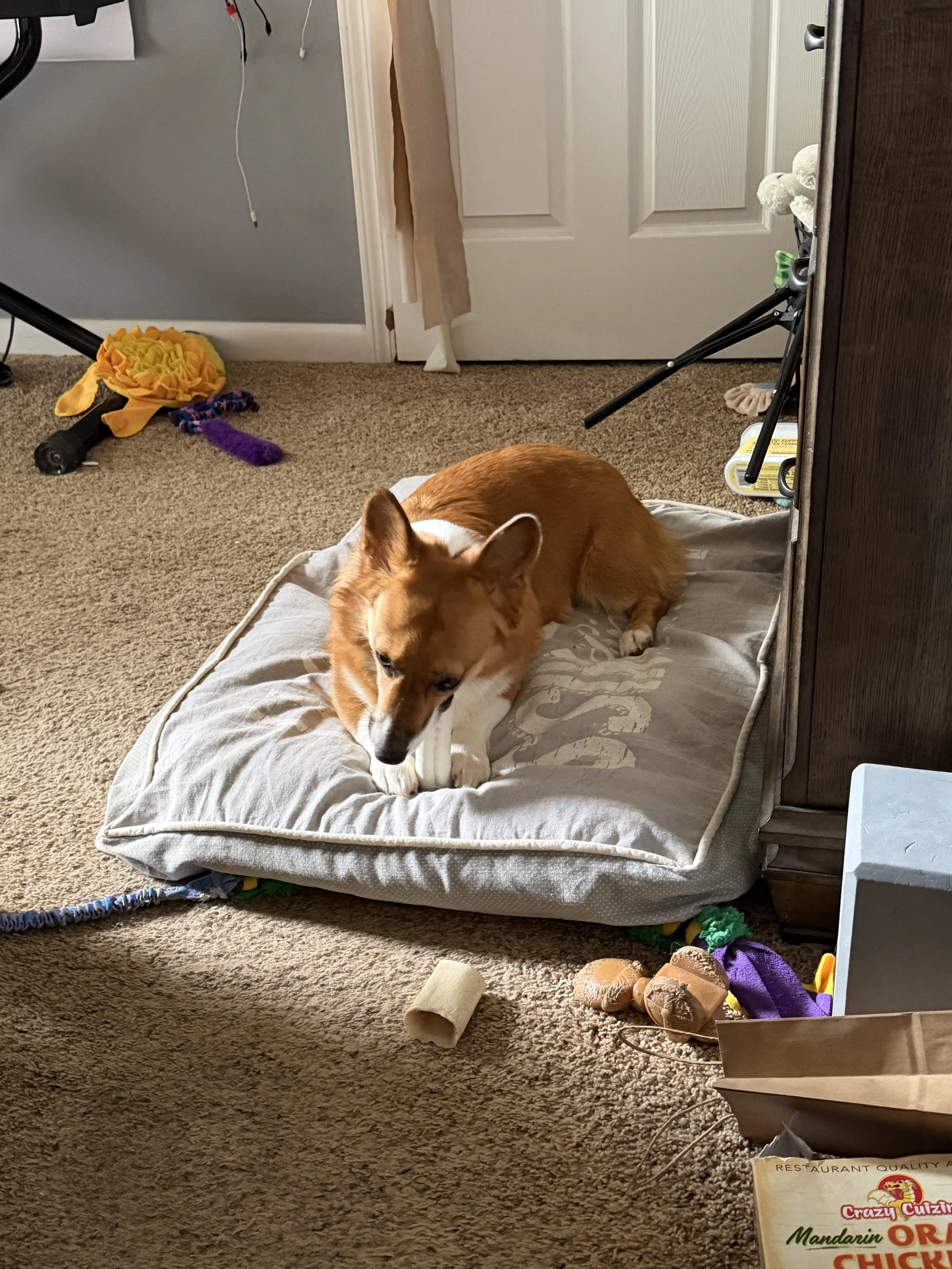
One of Tigerlily’s safe spaces is my office. Any time she gets a high value item, or needs a break she knows to “go to your office.”
This can look like
going from standing to laying down
eyes looking all over to slow blinking
big deep exhales.
If you are near your dog when this happens, you can talk softly to them and drop a treat slowly between their front feet. Letting them know that you want to see more of what they just did.
The space is evolving
Now your dog is on their way to have a safe space for whenever they need it. In the next post we’ll go over teaching your dog how to go there when they need it most. But for now, keep building it up as the best place to hang out. Watch for signs they are using it more, or for longer periods. This will be the big indicator that you’re on the path to success!
Having trouble doing this on your own? Reach out today and let’s chat about how I can help.
Hi! I’m Beccy and I’m a professional dog trainer with almost 15 years of animal training experience. I use positive reinforcement and fear-free methods to help dogs and their humans build skills, confidence, and lasting behavior change. My goal is to create a less stressful life for you and your dog. I offer in-home training in Maryville, TN and surrounding cities throughout Blount, Sevier, Knox, and Loudon Counties. Online training is available for clients outside of East TN.
